Condo, Townhome or Apartment Near The Battery: How Do They Compare?
Cobb County
Cobb County
Deborah Morton, Managing Partner, The Agency Atlanta. RealTrends Top 1.5%.
A condo, a townhome and an apartment near The Battery Atlanta differ most in what you own, what you pay each month beyond the mortgage or rent, and how much say you have over the building around you. Renting keeps you flexible, a condo means owning the inside of your unit and sharing everything else, and a townhome usually means owning the whole home and the land under it, with an association handling shared spaces.
The district makes the point on its own website. Click "Live" in The Battery Atlanta's main menu and it sends you to a rental apartment community at 900 Battery Avenue SE, on the same street as the ballpark, with one-, two- and three-bedroom layouts. The same site's event listings warn that road closures go into effect before large events.
The longer version matters, because each kind of home lives differently on an ordinary Tuesday and on a game night. This guide covers the practical questions first, then the daily rhythm around them.
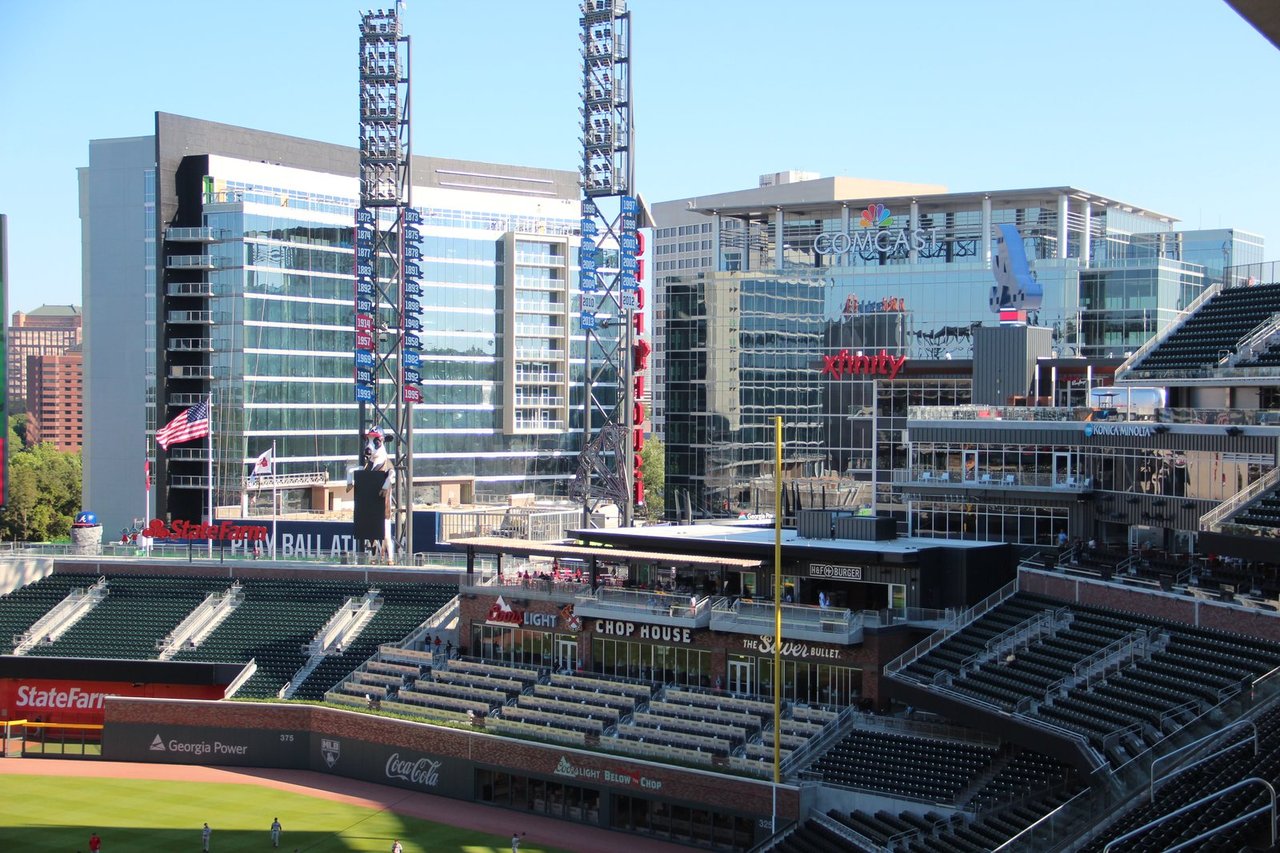
The Battery and Truist Park are in the Cumberland area of unincorporated Cobb County, about 10 miles northwest of downtown Atlanta. The ballpark's address is 755 Battery Avenue SE, Atlanta, GA 30339, but that "Atlanta" is a mailing city, not a city limit.
Cobb County's city-boundary map shows the ballpark outside every city. A U.S. Census Bureau geocoder check of the same address returns Cobb County and the Cobb County School District, with no incorporated city at all.
For a housing decision, that means Cobb County property taxes and services, and the Cobb County School District rather than Atlanta Public Schools. For how the levies compare across the county line, see Cobb County vs. Fulton County property taxes.
It is worth confirming this for any specific address, because ZIP codes and city boundaries do not always line up. The school district also notes that its attendance zone maps are for general information only and should not be the sole basis for a home purchase, so confirm the assigned schools with the district directly.
In a condominium, you own your unit, usually from the interior walls inward, and you share ownership of the common elements such as the roof, hallways, structure, grounds and amenities. Georgia regulates this under the Georgia Condominium Act, which begins at O.C.G.A. § 44-3-70. The association collects monthly dues and is responsible for maintaining the shared parts.
A townhome is different in one important way. In many townhome communities, you own the home and the small piece of land beneath it, and the association maintains common areas such as entrances, landscaping and sometimes exteriors.
Georgia's Property Owners' Association Act, which begins at O.C.G.A. § 44-3-220, governs many of these communities. Fannie Mae's mortgage guidelines describe the same setup as a planned unit development, where owners hold title to the lot and the structure plus an interest in an association that owns or manages the common areas.
Some townhome communities are legally organized as condominiums instead, so the label on the listing does not settle the question. Under Georgia law, both kinds of community are created by recording a declaration, and that recorded declaration tells you which one you are buying.
That distinction matters in real life. It changes what your monthly dues cover, what insurance you carry, who pays when the roof or siding needs work, and how a lender looks at the purchase.
Flexibility is the headline. With a lease, you commit for a set term, and the owner handles repairs, major systems and the building's insurance. You are not exposed to a special assessment, and you can leave at the end of the term without selling anything.
The trade-off is that your housing cost is not building equity, the rent can change when the lease renews, and you have less control over the building itself. Floor plans, lease terms and fees vary by community, so compare them the way you would compare buildings.
Availability and pricing move often, so treat any figure you see in an article as a starting point.
No single number is fair here, because pricing varies by building, floor plan and year. What stays constant is the structure of the costs, and that is what you can compare.
The insurance line deserves a closer look. Fannie Mae's guidelines, which many lenders follow, require a condo borrower to carry a unit owner's policy when the master policy does not cover part of the unit's interior or improvements, or when the master policy has a per-unit deductible.
The mistake we see most often is comparing a rent payment to a mortgage payment and stopping there. Dues, taxes, insurance and the occasional special assessment belong in the comparison, and so does what you would otherwise spend on maintenance.
A condo purchase is partly a purchase of the association's financial health, so ask early how owners can review the association's records. Before you commit, ask for and read the following.
That lender point is real. Fannie Mae describes its condo project review as separate from, and in addition to, the review of the borrower and the unit's appraisal.
Nothing on that list is unusual; it just gets skipped when the view is persuasive. A good buyer's agent will ask for these documents early, and an attorney can review the declaration when something is unclear.
It can be. If you are considering a unit in a building that is new or still under construction, get the pricing, the delivery date and the association details directly from the developer, in writing, rather than from press coverage, which can lag behind the project.
Lenders draw the same line. Fannie Mae treats a condo project as new when fewer than 90% of its units have been sold to buyers, when it is not fully complete, or when the developer still controls the association, and the review requirements differ for new and established projects.
As a general matter, newer buildings tend to have newer systems and fewer near-term repairs. They can also have associations that are still young, with a developer involved in early decisions, and a reserve fund that has not had time to grow. Neither is a mark against a building; both are questions to ask.
Think about a regular week rather than a game night. A unit in a mid-rise building often means an elevator or stairwell, a shared parking deck, a package room and neighbors above and below.
A townhome often means a garage or driveway, a few stairs inside, a small patio and a shared wall on one or both sides. An apartment can look like either, depending on the community.
Noise travels differently in each. Shared floors and ceilings carry sound in a way that shared walls with a fire-rated separation sometimes do not. If quiet matters to you, visit at the hours you would actually be home, including a weekday evening and, if you can, on a day with an event nearby.
Storage is another quiet deciding factor. Condos and apartments often have limited closet and garage space, while townhomes more often have a garage and a bit of attic or flex space. Anyone with golf clubs, bicycles or holiday decorations will notice.
Living near a ballpark and entertainment district brings walkable dining, music and a lively atmosphere, along with traffic, crowds and occasional noise on event days.
The Braves play 81 regular-season home games, and the Coca-Cola Roxy and other venues at The Battery host concerts and events as well. The Battery's event listings note that road closures go into effect before large events, which matters most if your parking deck or garage opens onto a closed street.
The experience differs from one address to the next. A home within a short walk of the entertainment district feels different from one a mile away with a quick drive, and our look at what it is really like to live near Truist Park walks through traffic, noise and transit in more detail. Ask neighbors, and visit on a game day before you commit.
Often. If your current home is paid down, comfortable and close enough to what you enjoy, a move to a smaller place near The Battery may cost more per square foot than you expect, with dues and taxes on top.
Some people are better served by renting a unit near The Battery for a year first, to learn whether the area suits their routine before buying anything. Others find that a townhome or condo near the ballpark makes sense because it removes yard work and lets them lock the door and travel.
Both are reasonable conclusions. The right choice is the one that holds up when you list the monthly cost, the daily rhythm and your plans for the next five years. For the wider county picture, see our pros and cons of living in Cobb County.
There is no single best answer between a condo, a townhome and an apartment. There is only the one that fits how you actually spend your weeks.
No. They are in the Cumberland area of unincorporated Cobb County, with an Atlanta mailing address. Property taxes and public schools follow Cobb County and the Cobb County School District.
Both fund shared costs. A condo association's dues typically cover more, such as building insurance, structure and common systems, while a townhome association's dues often cover common areas and sometimes exteriors. The governing documents say exactly what is covered.
A home inspection of the unit is still wise, and a review of the association's records and reserves matters as much. An attorney can review the declaration if anything is unclear.
Condominiums fall under the Georgia Condominium Act (O.C.G.A. § 44-3-70 and following). Many townhome communities fall under the Georgia Property Owners' Association Act (O.C.G.A. § 44-3-220 and following). Which one applies depends on how the community was legally created.
Often, yes. Fannie Mae's guidelines have lenders confirm that a condo project meets its eligibility standards, a review separate from the borrower's own. Ask your lender early whether the building works for your loan type.
It depends on your timeline and comfort. Renting first can teach you a lot about daily life in the area at a known cost. Buying makes more sense if you plan to stay for several years and the numbers hold up.
Checked October 28, 2026.
Questions? Call (470) 990-4414.
Start Your New Home Search Now!
Stay up to date on the latest real estate trends.
You’ve got questions, and we can’t wait to answer them.