Living in Ball Ground, GA: An Area Guide for Buyers and Sellers
Community

Community
Living in Ball Ground GA means a small railroad town with a historic main street, a growing park system and quick access to I-575, set on the northern edge of Cherokee County where subdivisions give way to pasture and woodland. This guide covers downtown, parks and events, housing, commute routes, city versus unincorporated addresses and utilities, with practical notes for buyers and sellers.
Ball Ground is a small city in northern Cherokee County built around a compact historic downtown, with newer subdivisions near the interstate and farms, forest and large tracts farther out. The city describes itself as a quaint town known for its historic main street, unique shops and restaurants, numerous historic homes and recreation opportunities. Daily life centers on Gilmer Ferry Road, the city parks and a full calendar of downtown events.
The city places Ball Ground on metro Atlanta's northern edge, in the Appalachian foothills. According to Explore Georgia, the community was almost purely agricultural before the railroad came through in 1882, and the town then grew with the marble-working industry.
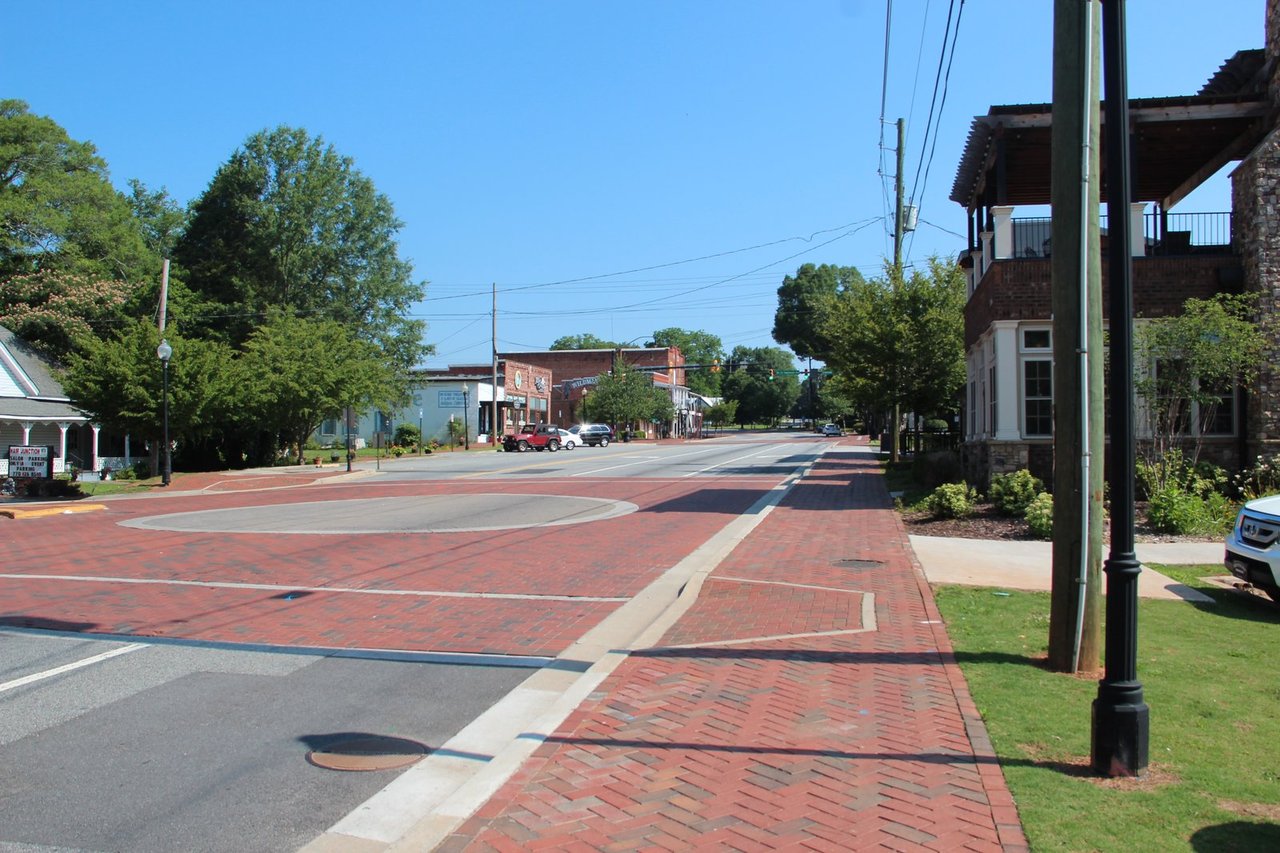
Downtown Ball Ground is a compact commercial district along Gilmer Ferry Road, which serves as the town's main street, surrounded by historic homes inside a National Register historic district. It holds one and two story brick commercial buildings, shops and restaurants, a city park beside the railway and City Hall on Valley Street. Downtown businesses licensed by the city to serve alcohol can apply for a permit to serve open container drinks to go.
The National Register nomination for the Ball Ground Historic District describes Gilmer Ferry Road as Ball Ground's "Main Street," with commercial buildings concentrated in a central three-block area and dating mostly from the 1900s through the 1930s. The district counts 114 contributing buildings, most of them residential. Residential styles named in the nomination include Queen Anne, Italianate, Folk Victorian, Colonial Revival, Classical Revival and Bungalow/Craftsman.
The city's Quarter Three 2026 newsletter reports that on September 26, 2026, the city awarded historic preservation markers to The Ball Ground House, a 1905 home restored as short-term lodging, and the Ball Ground Burger Bus, which operates out of a 1948 vintage Atlanta Transit Authority trackless electric trolley.
According to the city's Quarter Three 2026 newsletter, Cherokee County and the Georgia Department of Transportation have scheduled a public input meeting on the proposed Ball Ground Truck Bypass for October 13, 2026, at 4 p.m. at the Bluffs. The Cherokee Tribune and Ledger-News has reported that the project is designed to divert large trucks away from downtown, with construction slated to begin in 2029. Buyers near SR 5 or SR 372 can follow county and GDOT notices.
Ball Ground's parks include Calvin Farmer Park, a 15-acre park with picnic pavilions, a playground, a duck pond and a performance stage, plus the Ball Ground Botanical Gardens, a city park beside the railway, the Roberts Lake Trail and Park, and the Valley District Linear Park. An adjoining sports complex adds a ball field, tennis courts and a basketball court.
The city's Parks and Recreation page describes open fields and wooded areas with a small stream at Calvin Farmer Park, and the Cherokee Office of Economic Development lists a 0.6-mile loop there. Ball Ground Botanical Gardens at 215 Valley Street features native Georgia plants and trees and a butterfly garden, and it can be rented for events. Ball Ground City Park is a shady downtown spot beside the railway used for concerts and outdoor movies. The Valley District Linear Park serves walkers, joggers and cyclists, and the City Gym on Church Street, within walking distance of downtown, serves recreational and travel teams.
The city describes Roberts Lake Trail and Park as a 45-acre green space along Long Swamp Creek with a hiking trail, fishing and the ruins of a historic dam and power generation site. The city's Quarter Two 2026 newsletter reports that staff installed a new sign marking the Roberts Lake Trailhead on June 5, 2026, along with additional signage at Calvin Farmer Park.
Just outside town, Cherokee County purchased about 24 acres in 2019 at the confluence of Long Swamp Creek and the Etowah River for a recreation area. The Cherokee Tribune and Ledger-News reported in December 2024 that the county planned to open it in early May 2025 with a canoe and kayak launch, an archery range, primitive campsites, a walking trail and a rentable pavilion; check Cherokee Recreation and Parks for current hours. Gibbs Gardens, at 1987 Gibbs Drive, spans a 336-acre estate that Explore Georgia says includes a 50-acre daffodil collection, more than 40 acres of Japanese gardens and the Monet Waterlily Gardens.
The City of Ball Ground publishes a yearly event calendar built around recurring downtown gatherings and seasonal festivals. Third Thursday and Second Saturday events repeat through much of the year, and larger events include BBQ and Brews, Art on Main, a Chili Cook-Off, fall festivities, a hometown tree lighting and a holiday market. The city labels its 2026 schedule as tentative and updates it as needed.
Remaining 2026 dates on the city calendar include the Chili Cook-Off on October 17, Spooktacular on October 23, the Hometown Tree Lighting at the Garden on November 28 and the Holiday Market on December 5 and 6. The city's Quarter Two 2026 newsletter reports that its 11th annual fireworks show on June 27, 2026, drew thousands of spectators.
Ball Ground's housing is primarily detached single-family homes, with some townhomes and a single 80-unit apartment complex, according to the city's comprehensive plan update adopted in July 2023. The mix runs from historic homes near downtown, to newer subdivisions in growth areas near infrastructure, to large-lot estate homes, farms and wooded tracts in the rural parts of the area.
The comprehensive plan describes the Urban Core, which includes the Gilmer Ferry main street area, the Canton Highway commercial areas, the I-575 and Howell Bridge interchange and the historic district, as offering housing that ranges from townhouses to historic homes. The historic district nomination places most of the district's housing between 1900 and 1940 and documents Victorian, revival and Craftsman styles.
The plan's Suburban Growth character area consists of single-family detached homes on lots of varying size with shallower setbacks than in rural areas, in places where public water is available and sewer may be available or planned. The 2023 plan also noted that approximately one third of homes in Ball Ground were valued between $300,000 and $500,000, a figure that reflects conditions at that time rather than today's pricing.
The plan's Rural Places character area is land typically cultivated as pasture, farmland or managed woodland, or sparsely settled homes on individual tracts, including large-lot estate-style homes. Public water may reach some of these areas, but the plan states that sewer is generally not available or planned there. Acreage buyers should also review tax programs and creek setbacks; see our guides to conservation use covenants on Cherokee acreage and creeks, stream buffers and buildable ground.
Ball Ground sits along I-575 at exit 27, north of Canton, and the city's comprehensive plan identifies I-575 and State Route 5 as the major routes for regional connections. State Route 372 is the only major east-west connection. Trips south toward Canton typically start on I-575, while SR 372 and SR 5 carry local and cross-county trips.
Buyers comparing homes should drive the route at the hours they will travel, since a home near downtown and a tract on a county road can have different access to the interchange.
Not always, and it is worth confirming before you buy or list. Jurisdiction affects who issues building permits, which utility provides water and sewer and which zoning rules apply. The City of Ball Ground issues building permits within city limits, while the county directs unincorporated properties to the Cherokee County Water and Sewer Authority for sewer and water questions.
Utility service alone does not settle the question. The city's water and sewer department serves approximately 1,300 households both inside and outside the city limits, so a property on city water may still sit in unincorporated Cherokee County. The city's Planning and Zoning department handles annexation applications, which the city reviews before Cherokee County's comment period. Ask the city or Cherokee County which jurisdictions apply to a specific parcel.
Homes in and around Ball Ground may be served by city water and sewer, Cherokee County Water and Sewer Authority service, a private septic system, a private well or a combination. The city's comprehensive plan lists public water and sewer as available or planned in its Suburban Growth areas, while sewer is generally not available or planned in its Rural Places areas, so acreage there may rely on septic. Confirm each property's setup early.
According to the city's Water and Sewer Department page, customers receive water from a single well constructed in 1938, treated with chlorine and fluoride, with backup connections to the Cherokee County Water and Sewer Authority. For new construction, the city's building department states that water and sewer capacity fees must be paid before a building permit is issued, and that development impact fees became effective October 11, 2024.
Cherokee County directs septic questions to the Department of Health, North Georgia Health District, at 770-479-0444. Buyers can ask that office about permit records for an existing system and can hire a septic contractor to evaluate the system during due diligence. A Georgia real estate attorney can explain how septic findings fit into contract terms.
Some rural Ball Ground properties rely on private wells. Water testing, well records and lender requirements for wells are covered in our guide to buying a home with a private well in Cherokee County.
Ball Ground transactions often turn on property details more than the address alone: jurisdiction, utility type, lot features and nearby road projects. Buyers should confirm city or county status, utilities and any covenant or buffer limits early. Sellers should gather utility bills, septic and well records and documentation of historic features so buyers can evaluate the home quickly and with confidence.
Request the parcel's jurisdiction, utility providers and septic or well records early. For historic homes near downtown, ask about the age of plumbing and service lines; the city reports it has identified six remaining customer-owned galvanized service lines in its inventory. Work with your lender, insurance agent and a Georgia real estate attorney on items specific to your financing and contract.
Prepare a property file that shows recent utility bills, septic pumping or inspection records, well test results and any permits for additions. For homes in the historic district, document architectural features and dates of work. A market analysis based on comparable homes with similar lot size, utilities and location gives a clearer price opinion than area averages, since an in-town historic home and a rural tract on septic draw different buyers. Full open-market exposure helps every interested buyer see the listing.
Where is downtown Ball Ground? Downtown centers on Gilmer Ferry Road, which the National Register nomination describes as Ball Ground's main street, with City Hall and the Ball Ground Botanical Gardens at 215 Valley Street and a city park beside the railway.
What is the main park in Ball Ground? Calvin Farmer Park is a 15-acre city park with two picnic pavilions, a playground, a duck pond, open fields, wooded areas with a small stream and a performance stage. A sports complex with a ball field, tennis courts and a basketball court adjoins it.
Does every Ball Ground home have public sewer? No. The city's comprehensive plan states that sewer is generally not available or planned in its Rural Places character area, so acreage there may rely on septic systems. Confirm each property's sewer or septic status with the utility provider or the North Georgia Health District.
Living in Ball Ground GA offers a historic downtown along Gilmer Ferry Road, a city park system anchored by Calvin Farmer Park and Roberts Lake, river and garden destinations nearby, and housing that ranges from Victorian-era homes to newer subdivisions and rural acreage. Because jurisdiction, utilities and land features vary from parcel to parcel, details matter on both sides of a sale. If you are considering buying or selling in Ball Ground, contact Clareo Real Estate for a conversation about your situation.
Start Your New Home Search Now!
Stay up to date on the latest real estate trends.
Community
Community
Kennesaw
Alpharetta
You’ve got questions, and we can’t wait to answer them.